Where Simulation Makes the Biggest Difference in Skilled Trades Training
The skilled trades are physical work, but a lot of what makes a job challenging happens in a technician’s head. A rooftop unit that stops cooling could have 30 different causes. Finding the right one takes judgment and skills built from experience and from seeing a wide range of problems.
Simulation is one of the best ways to build and accelerate that judgment. This is the second post in The Skills Stack, our series on where high tech meets the hands-on workforce. Each post looks at one layer of the stack, and every layer is tailored to each customer’s workforce:
- Content designed with precision on what’s physical and what’s digital
- Simulation that gives learners unlimited, risk-free practice
- Certification built on credentials employers define, with learning that continues after
- Workforce intelligence from skill verification
In our first post, we covered workforce intelligence and Skill Verification. This post covers simulation.
When Simulation Is the Best Choice
The Interplay Intelligence starts from one principle: every activity earns its modality. Following that logic, there are four key scenarios where simulation earns its spot as the clear choice for training and instruction:
- The Activity Is Primarily Cognitive – Simulation is most valuable when the hard part of a task is a mental challenge. Diagnostics is the clearest example. A technician has to take a reading, rule out causes and decide what to check next. In a simulation, learners work through that logic, see the result of each decision and try again with feedback. Good training challenges people to understand why a job is done a certain way, and working through those decisions over and over is how that understanding sticks.
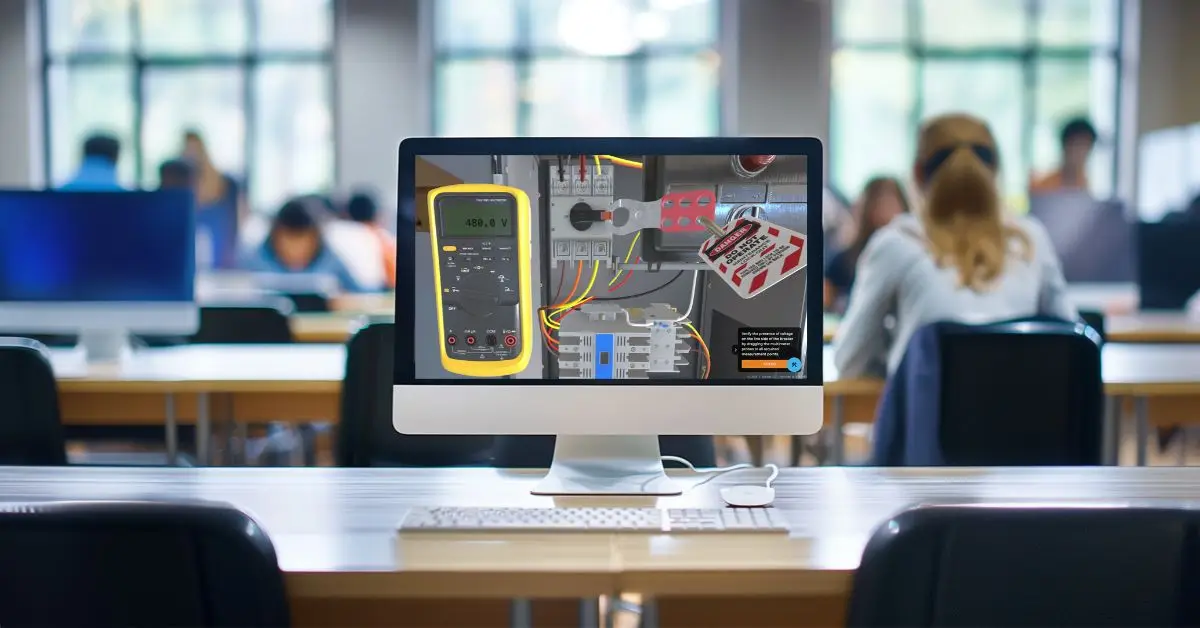
- Tasks With Many Variables Need Scenario-Based Practice – When a task has many variables, learners need to see it many ways. A simulation can change the fault, the equipment or the conditions on every attempt, so learners build judgment that holds up across situations instead of memorizing the answers. Our simulations build that practice in stages. In training mode, the simulation walks the learner through each step and highlights where to work. In challenge mode, the step-by-step guide stays, but the highlights come off, so the learner has to find the right path on their own.
- The Real Thing Is Hard or Risky to Create – Some situations are dangerous to practice on live equipment, and some are hard to produce on demand. Before I started Interplay, I worked at a company that trained residential energy auditors. Field training meant walking 20 students at a time through a volunteer’s home, which was a logistical challenge for us and a real inconvenience for the homeowner. The military, medicine and aviation had already solved that kind of problem with simulation, and that’s why we built Interplay for the skilled trades.The same logic applies across the trades. You can’t always have a frozen evaporator coil ready when a class needs to see one, but a simulation can present a frozen coil every time. The same goes for faults that could damage equipment or put someone at risk if a learner got them wrong.
- When You Need Years of Exposure, Condensed – A technician might go years before seeing certain failures in the field. In simulation, they can work through those situations in weeks. Field experience still matters, and a new technician who has already worked the problem in simulation arrives at a service call or job site better prepared for it.
Simulation works best alongside expert-built video and instructor-led training, and not every skill calls for it. In our next post, we’ll walk through how we decide which format fits each part of a program.
What It Looks Like in the Field
At IRT Living, maintenance technicians troubleshoot HVAC, plumbing, electrical and appliance problems across 121 apartment communities. Inconsistent exposure to troubleshooting on the job slowed their development, so IRT added 3D simulation courses that let technicians practice diagnostic steps in a controlled environment. Mike Szramek, IRT’s facilities senior vice president, said the courses walk technicians through troubleshooting in steps they fully understand, and they have to move the test probes themselves to check voltage. Within five months of relaunching the program, average work order completion times dropped.
Total Comfort Solutions, an HVAC company with technicians spread across three states, built its technician development program around simulation-based training. Each technician follows a personalized plan with monthly course goals, and the company reports more confident technicians who solve problems faster. Shannon Broom, the company’s technician development specialist, calls Interplay’s interactive courses “a cornerstone of our technician development strategy.” Since building the program, Total Comfort Solutions has cut onboarding time in half, from 12 months to six, and its technicians have a 100% pass rate on EPA 608 certification exams.
The same approach works in a training program and on the job. A school can use simulation to give students practice on faults its shop can’t stage. For employers, the usual way to ramp a new technician is job shadowing. It has real value, but not every experienced technician is a good trainer, and mentoring gets harder to deliver as experienced workers retire. Simulation works like a mentor that scales, so an employer can build troubleshooting skills between service calls without pulling a senior technician off the job to teach.
What Comes Next
Simulation is one layer of the Skills Stack, and it works best alongside the others. Knowing when to use it is part of a bigger question: which format fits each part of a training program. Next in this series, we’ll look at the content layer and how we make that call for every hour of training.
Think of a skill your team or students struggle to practice today. We’d like to hear what’s making it hard.