There’s a question that follows CTE directors from budget season to budget season: How do we grow our trades programs without growing our footprint?
It’s a fair question. Skilled trades training has always been physical by nature. The equipment is heavy. The labs are specialized. The safety risks are real. But as learning evolves, it’s worth examining the assumption that more skilled trades training requires more square footage.
By reframing your strategic growth plan to include digital infrastructure, you can plan a strategy that lays the groundwork for future innovation and makes every dollar you spend on physical equipment stretch further. Plus, we’ll share six practical strategies to bring into your next budget meeting.
Rethinking Educational Infrastructure
When your district lays fiber for a new building, no one calls it a technology purchase. They call it infrastructure. It’s the foundation required for your programs and all communication. It’s the Internet connection that makes every Chromebook, every gradebook, every digital resource in your schools usable.
Digital training infrastructure works the same way. It’s not a one-off program you buy; it’s digital real estate that you can leverage for years to come. The shift to building digital infrastructure is happening in workforce-ready districts right now, and it’s the foundation you need to serve students for the next 10, 20, or 50 years.
The Cost Per Foot Fallacy
Consider the cost of a traditional trades lab. A single physical HVAC training station, the kind that lets two students practice at a time, under direct supervision, can run $5,000 for a basic technician unit to $25,000 for a commercial training unit.
That’s even before you’ve bought refrigerant, copper tubing, or wiring. With every lab, students run through wiring, fittings, and refrigerant, and you haven’t even factored in ventilation requirements, liability insurance, specialized maintenance and upkeep.
Cost Per Foot vs Cost Per License
The cost per foot infrastructure model is inherently limited. Only a certain number of students can fit in a classroom and work on one station at a time. While tuition dollars and grant funding stay relatively flat, physical costs continue to rise.
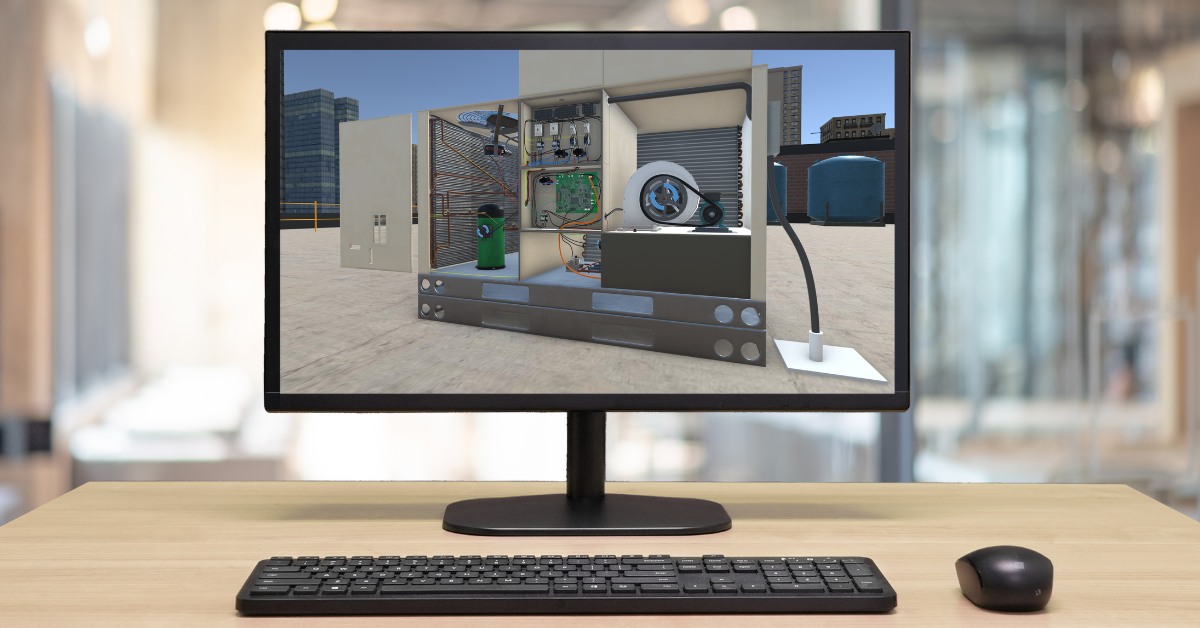
Instead of thinking in terms of cost per square foot, reorient yourself to think about cost per license. For the investment in one HVAC training unit that can only facilitate two students, you could build an entire virtual training lab to facilitate a whole cohort.
With digital technology, students can log in from any device and practice the same diagnostic procedure over and over again, with zero consumables cost. As students gain confidence, they maximize the physical lab time as the last mile of hands-on mastery. The Cost Per License approach is more scalable, with more predictable total costs.
The New Trades Program You Didn’t Think You Could Afford
The trades programs you offer aren’t always the trades that employers need most. They’re the ones you have the infrastructure and equipment for.
This might be woodshop because the shop has been there since 1980, or auto because someone donated a lift fifteen years ago. There’s nothing wrong with those programs, but the fastest-growing skilled trades right now (industrial maintenance, solar installation, facilities management, electrical, and HVAC) are facing skills shortages because districts don’t have the capital to expand or launch new programs.
Digital training infrastructure changes that equation. A district can effectively “install” a new career pathway, complete with structured curriculum, simulation-based practice, and industry-recognized credentials, without years of upfront fundraising, construction, and curriculum-building. Almost overnight, you can expand your district’s training capacity and offer training in a new skilled trade.
Overcoming the Depreciating Equipment Challenge
Physical lab equipment starts aging the moment it arrives. The technology it represents is fixed to the moment it was manufactured. Trades equipment is also vulnerable to industry changes. For example, the National Electrical Code is revised on a three-year cycle, and innovations like new heat pump technology are changing the way HVAC systems are diagnosed and serviced.
Cloud-based digital infrastructure runs on a continuous improvement model instead of a ten-year replacement cycle. When content is updated to reflect a new code, a new regulation, or a new technology, you get that update automatically.
For a district making a long-term investment in trades programming, that distinction matters. Your digital lab won’t age out simply by stagnant funding or waiting for the next large equipment grant.
Increased Equity and Access
There’s an equity issue hiding inside the way most districts structure CTE. The well-equipped trades lab, often at the regional tech center or the flagship high school, gets the best equipment and the latest technology. The alternative learning campus, the rural schools, or the programs running out of a converted classroom have to make do with the leftovers, such as second-hand textbooks, equipment, and dated videos.
This gap is real, and it compounds over time. The students who most need a clear pathway to a stable, high-paying trade are often the furthest from the physical resources that would give them one.
Digital training infrastructure is, at its core, an equity tool. Because it runs on any device with a browser, the lab can go anywhere the student is. The same simulation-based HVAC diagnostic that a student uses at the tech center is available to a student completing coursework in an alternative setting. The same credentials are within reach.
Instead of building a lab in one building, digital infrastructure allows you to fit a lab in a backpack and transport it to the students who need it most.
A Different Kind of Budget Conversation
You might be wondering how to apply this in your next budget meeting. When you think about a technology purchase as digital infrastructure, not just an app or tool that you’ll discontinue in a year, you can make a different case. Here’s how to approach your next budget conversation when asking for digital training funds.
1. Start With the Cost-Per-Student Math, Not the Platform Price
Don’t lead with what the total license costs. Lead with what your current lab costs per student, per year, once you factor in the regular cadence of purchasing new equipment, equipment maintenance, consumables, and the instructor time spent managing a two-student-at-a-time rotation. When you put those two numbers side by side, the comparison does the work for you.
2. Move It Out of the Technology Budget
If you’ve been trying to fit digital training infrastructure in your technology budget, it’s competing with devices, curriculum, and assessment tools. When it lives in instruction, it can be evaluated on learning outcomes, and you can make the argument that it’s necessary for instruction.
3. Anchor It to Employer Demand
School boards respond well to workforce data. Come in with specifics: which trades are your regional employers actively hiring for, what certifications they’re asking for, and which of those your current program can’t produce. Then show how digital infrastructure will close that gap for trades you aren’t currently serving or want to expand access to.
4. Make the Equity Case
If your district has a tech center that serves one zip code well and three others poorly, say so. Board members respond to the idea that a single investment can reach every building, every student, and every learning setting simultaneously. Frame it as expanding access and not just a software purchase.
5. Point to the Replacement Cycle You’re Avoiding
Ask your facilities or finance team what the district has spent on trades equipment in the last decade and what the replacement timeline looks like for the equipment currently in use. Then contrast that with a platform that updates automatically when industry standards change. An infrastructure investment is creating capacity today, and it’s also reducing your reliance on the equipment replacement cycle.
6. Shift from Capital Expenditure to Operational Expenditure
A traditional lab expansion is a capital expenditure conversation. You need a bond, a construction timeline, and board approval for a project that will take years to become a reality.
By contrast, digital training infrastructure is an operational expenditure. It lives in the instructional budget, not the facilities budget. For roughly the cost of one or two physical trainer units that serve two students at a time, a district can deploy a platform that serves an entire cohort across multiple sites, across multiple career pathways, in multiple languages, in the same school year the contract is signed.
When you shift your thinking from capital expenditure to operational expenditure, the conversation becomes bigger than just a technology pitch. It’s a different framework for thinking about what “investing in trades training” actually means in 2026.
Plan Your Infrastructure with Interplay Learning
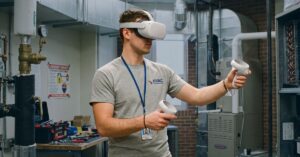
Interplay Learning was built around the idea that the right digital foundation doesn’t compete with hands-on training. Instead, it enhances hands-on training through immersive simulations, engaging course content, and gamification. Interplay Learning’s digital training programs help districts serve diverse populations, offer students the latest technology, and quickly adapt to workplace changes, all without a capital expenditure plan.
The districts that are getting ahead in trades aren’t the ones sitting around, waiting for a new building. They’re the ones who figured out that the most powerful upgrade to their program might not require a single brick.
Talk to a consultant to learn about Interplay Learning’s technology and outcomes.