
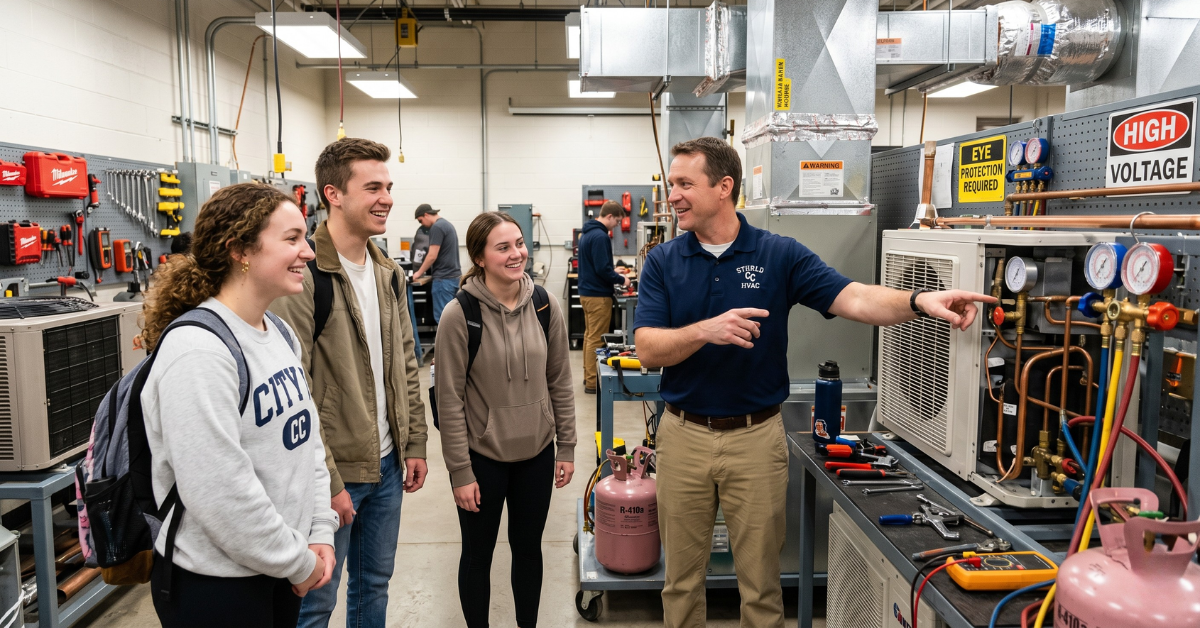
If your institution has recently launched a new trades program, congratulations! Vocational program enrollment is growing at 6.6% a year, more than eight times the growth rate for overall higher education. Gen Z students are pursuing skilled trades education at higher rates thanks to their fast path to entry, stability, and hands-on nature.
But renewed interest doesn’t guarantee a full class list when you launch a new trades program. You still need to market it, find students, and convince them to invest their time and tuition dollars in the program.
The audience and messaging for trades programs differ from most traditional degrees. This guide covers how to create messaging that will resonate with your audience, plus four marketing tactics to attract students to your program.
Understand Your Audience
First, understanding your audience is key to any marketing strategy. Marketing for trade schools requires some non-traditional student marketing and adult learning recruitment. Take time to explore data and talk to learners to understand who potential students are and what motivates them. A few key trends to know:
- Different demographics. Trade schools are growing in popularity among both high school graduates and adult learners. Some of the adult learners are retraining from a previous career or may even hold a bachelor’s degree. Women are still vastly underrepresented in skilled trade programs, but your program can help to change that.
- Different priorities. Typical college-bound students prioritize campus life, environment, and major and study abroad selection in their school selection. By contrast, trade school candidates prioritize affordability, job-ready skills, and employability in a specific field.
- Online learning remains popular. While three-quarters of students surveyed still prefer some in-person learning, online enrollment is growing. Today, 14.9% of all trade school enrollments are fully online.
- Flexibility is key. Since many adult learners balance caregiving and work commitments, flexibility is appealing with evening, online, hybrid, or self-paced options.
Create Outcomes-Focused Messaging
With this demographic in mind, create messaging that speaks to students’ hopes and priorities. Despite renewed interest, the skilled trades still face stigma, especially among female candidates.
Combat this with marketing content that emphasizes clear career outcomes, like employability, career progression, and wage growth.
- Fast path to entry: Emphasize that students can train and start working in months, not years, giving a higher immediate value.
- Employability and demand: Highlight job placements, apprenticeship pipelines, and demand for skilled workers in local markets.
- Stability: Stress that skilled trades offer steady demand, dependable career paths, and resilience across economic cycles.
- Hands-on work and sense of purpose: Lead with practical, equipment-based learning and real-world training instead of lecture-heavy classroom time. Show how students will tangibly impact their communities.
- Affordable ROI: Frame tuition as an investment with lower debt and a faster return through earlier earnings.
4 Tried-and-True Tactics when Marketing for Trade Schools
Marketing a trades program in higher ed requires outcomes-focused messaging, community partnerships, and visual formats like short-form video.
Once you have messaging and a campaign concept, choose at least three channels to market your program. Lean on your existing brand awareness and social media presence as an entry point for talking about your new program. Some content providers, such as Interplay Learning, will even provide promo kits that you can use to highlight your program.
1. Pitch Press Coverage
While paid advertising campaigns have their place, earned media offers high-value, free publicity that’s more credible than your ads. Pitch a trend piece to local media about the renewed interest in the trades and how your school is responding with the new program. For best success:
- Compile key stats about skilled trade shortages and average earnings in your area to share with journalists.
- Identify a few current students or instructors who are willing to be interviewed.
- Think in visuals and send images of students using simulations, or invite journalists to come try the technology themselves.
- Share your social media handles with journalists and re-share any stories or videos for secondary exposure.
2. Lean on Partners
Partners are some of your best champions to help reach an audience that you don’t already have access to. Reach out to contacts at workforce boards, industry groups, employers, and job centers for help advertising your program. Best of all, this tactic is completely free!
Send a ready-to-share kit with a program description, images, and links to learn more. Ask if they can include a blurb in their next newsletter, hang a poster, or share about the program on social media.
3. Showcase Your Tech at Community Events
You likely already have events as part of your marketing strategy, such as college fairs, job fairs, and community events. These are great connection points, but it’s hard to make your table exciting with traditional degrees or trade programs. Most booths look the same (more brochures and pens!).
Take advantage of your immersive technology to show, not tell, what your program is like. Bring a laptop set up with 3D simulations or a VR headset of your skilled trades programs. Don’t forget to take photos and videos at the event to share online!
4. Create Short-Form Video
Short-form video is far and away the highest-ROI marketing format for institutions in 2026. This format brings high engagement, relatively low production cost, and strong performance across platforms. The amount of low-cost video editing and AI editing tools means that there’s simply no excuse not to create student recruitment videos.
Video concepts like “A Day in the Life,” FAQ/mythbusting and lesson or classroom previews perform well.
For best results, aim for:
- Vertical orientation for viewing on a phone
- Less than three minutes long, but ideally 15 to 90 seconds
Start Building Your Trades Program Pipeline
Marketing a new trades program requires a deliberate shift from traditional higher ed playbooks to outcomes-driven, visually compelling campaigns. When you align your messaging with what today’s learners value — fast career entry, affordable ROI, and flexible learning — you’ll resonate with students and grow high-quality enrollment.
At Interplay Learning, we’ve helped hundreds of institutions launch or modernize their trades programs through industry-leading 3D simulations and VR training.
Get in touch to learn how to attract students with immersive technology and see our products in action.