Verified Job-Ready: HVAC Technician I

The full certification that proves entry-level HVAC technicians can do the job, not just describe it.
Interplay Learning has built simulation-based training and assessment for the skilled trades, including HVAC, electrical, plumbing, and facilities maintenance for over 15 years. More than 2,000 employer organizations use Interplay to onboard and develop technicians in residential, commercial, and institutional settings. That work gives us an uniquely close view of what employers expect from entry-level workers and where new hires struggle. The Verified Job Ready credentials grew out of that experience. They give employers, educators, and candidates a standard, trustworthy way to show that someone can do the work, not just that they finished a course.
Each Verified Job Ready credential is built on a published occupational standard that defines the job functions and competencies of the role, and every competency is assessed. Candidates earn the credential by passing a proctored written exam and a hands-on performance assessment in a simulated system environment. The performance assessment is scored on the actions candidates actually take and is evaluated independently, never by the candidate’s own instructor. Items are written by credentialed subject matter experts and reviewed for technical accuracy, quality, and bias, and the passing score is set through a documented standard-setting study. The credential is open to anyone who meets the eligibility requirements, and no Interplay coursework is required, so any training program can prepare candidates for it. Every credential can be verified, stays valid for three years, and is renewed through documented continuing education or reassessment. That keeps the credential tied to current industry practice.
Verified Job-Ready: HVAC Technician I certifies that a worker can perform the job functions of an entry-level residential HVAC technician. The credential is built directly from the Residential HVAC Technician occupational standard and assesses all competencies across seven job functions, from safety and tool use to electrical fundamentals and refrigerant handling.
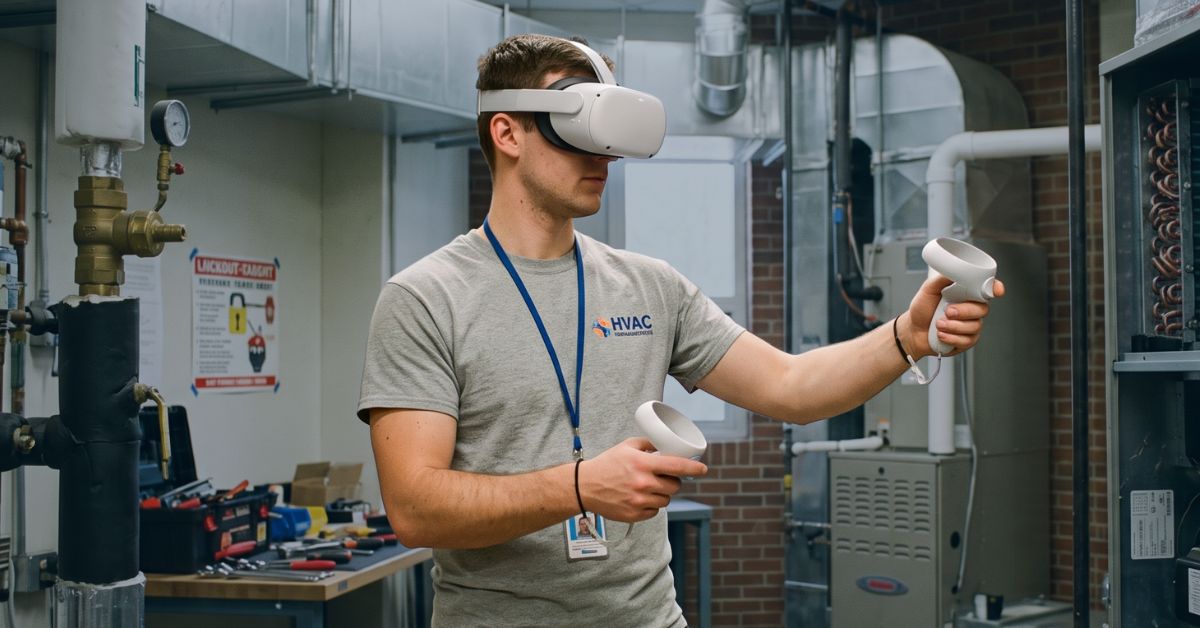
Techs prove their skills through an action-scored performance assessment, completing real service and maintenance tasks and getting scored on the sequence, accuracy and safety of what they actually do, not on a written description of what they would do. Every item and task is developed by credentialed subject matter experts and reviewed for technical accuracy, so employers can trust that a Verified Job-Ready holder is ready to contribute on day one.
Why Is This Credential Valuable?
Verified Competence
Certifies proficiency across all 47 entry-level HVAC job competencies through an action-scored performance assessment, not a course-completion certificate.
Enhanced Employability
Gives candidates a credential employers can independently verify, backed by content developed and reviewed by industry practitioners.
Immediate Workforce Entry
Requires no prior degree, licensure or employment history, making it attainable for secondary students, pre-apprenticeship participants and adult career changers alike.
Assessment at a Glance
| Written Assessment | Performance Assessment | |
|---|---|---|
| Number of Questions/Tasks | 70 scored (plus 7 unscored pretest items) | 4 tasks |
| Time Limit | 105 minutes | 60 minutes total |
| Proctored | Yes | Yes |
| Format | Computer-delivered; multiple choice, multi-select and numeric entry; closed book | Action-scored tasks on simulated HVAC systems |
| Sessions | May be administered in one session |
Eligibility
There is no minimum age, degree, licensure, employment, or prior credential requirement, and no on-the-job hours are required. The credential is attainable by secondary students, postsecondary students, pre-apprenticeship participants, and adult learners through the same instrument and the same standard. Candidates are expected to have completed a minimum of 150 hours of associated instruction and supervised practice, though completion of a specific program is not required.
Preparation
Candidates may prepare through any instructional program covering the competencies published in this blueprint. Completion of Interplay Learning coursework is not required to sit for the assessment or to earn the credential. The full competency list is published here specifically so that any program can prepare candidates against it.
Administration
The assessment is administered in a proctored setting. The proctor of record may not be the candidate’s classroom instructor. Where remote administration is offered, a live proctor observes the candidate, the assessment, and the testing environment throughout the session. For additional information, please contact credentials@interplaylearning.com
Retake policy
A candidate may attempt the assessment a maximum of three times in an academic year, with a minimum of twenty calendar days between attempts. An attempt invalidated for a testing irregularity not caused by the candidate does not count toward this limit and may be rescheduled without the waiting period.
Results
The assessment is scored by Interplay Learning. Results are reported as an overall scale score with a pass or fail determination, together with domain-level performance information for the candidate and the instructor. Domain-level results are reported for instructional purposes and do not independently determine the pass or fail outcome. Results are available within 10 business days.
Accommodations
Documented accommodations, including extended time, are provided in accordance with a candidate’s IEP, 504 plan, or equivalent documentation. Accommodation requests are made at registration. The assessment experience conforms to WCAG 2.1 Level AA.
Validity period and recertification
The credential is valid for three years from the date of issue. A holder may recertify by documenting 16 hours of continuing education in the occupation from any provider, by passing the current version of this assessment, or by earning the HVACR Technician Level II credential. A credential that reaches its expiration date without recertification enters a 90-day grace period, after which it lapses and may be reinstated within 12 months by reassessment.
Expiration does not alter the fact that the credential was earned. A credential earned during a reporting year remains a valid attainment record for that year regardless of its later status.
Verification
Each issued credential carries a unique identifier, a first-issued date, a current expiration date, and a status of active, expired, or revoked.
Assessment security and conditions
The assessment is closed book and closed reference. Candidates may not consult notes, manuals, textbooks, or online resources during administration, except for reference data supplied within the assessment itself.
Assessment content is confidential. Items are drawn from a secure pool and presented in randomized order, and the scoring key is never transmitted to the candidate device. Content may not be reproduced, retained, photographed, or disclosed. An assessment may not be used to satisfy the requirements of more than one credential. A candidate found to have compromised assessment security forfeits the attempt.
Review cycle
This blueprint is reviewed annually. The underlying occupational standard and job task analysis are refreshed every three to five years, or sooner where occupational practice changes materially. The credential validity period is set to align with that refresh cycle.
Safety and Workplace Standards — 14%
Job function: follow safety procedures and workplace standards.
- Comply with workplace safety regulations and codes
- Use personal protective equipment correctly for each task
- Safely handle, transport, and store hazardous materials
- Apply lockout/tagout and electrical safety protocols
- Follow safe procedures for piping, tubing, and pressurized systems
- Maintain job site safety through housekeeping and fire prevention
- Interpret and store HVAC documentation
Professionalism and Communication — 10%
Job function: demonstrate professionalism and communication.
- Collaborate effectively with team members
- Apply communication strategies to explain services
- Deliver respectful, responsive customer service
- Demonstrate professional conduct
- Use basic computer applications for service documentation
Tools and Instruments — 18%
Job function: use HVAC tools and instruments safely and correctly.
- Use basic HVAC hand tools
- Use specialty HVAC hand tools
- Use HVAC safety and diagnostic tools
- Operate drilling and fastening power tools
- Operate cutting power tools
- Use refrigeration diagnostic tools
- Use electrical testing instruments
- Use refrigeration and airflow instruments
- Use combustion and exhaust analysis tools
- Use temperature and environmental instruments
- Apply basic math to HVAC tasks
Basic Electrical — 16%
Job function: apply basic electrical knowledge.
- Apply basic electrical safety protocols
- Identify HVAC electrical components
- Interpret basic electrical diagrams
- Use electrical meters to verify circuits
- Explain basic electrical principles
- Perform proper wiring practices
- Comply with residential electrical codes
Piping and Tubing — 12%
Job function: assist in piping and tubing fabrication.
- Apply safety procedures for piping systems
- Interpret basic piping diagrams
- Select appropriate piping materials
- Measure, cut, and prepare piping
- Join, support, and seal piping
System Operations and Maintenance — 16%
Job function: perform basic system operations and maintenance.
- Describe HVAC system operation
- Perform system startup and shutdown
- Replace filters and clear condensate drains
- Clean accessible coils safely
- Inspect ducts and registers
- Record and report system data
- Apply safety and tool use practices during service
Refrigerant Fundamentals — 14%
Job function: demonstrate basic refrigerant knowledge.
- Identify residential refrigerants and their properties
- Explain the refrigerant pressure-temperature relationship
- Prepare for safe refrigerant handling
- Perform supervised refrigerant handling
- Use leak detection tools
Want to Learn More?
Product Overview: Build the Workforce You Need to Grow Your Residential HVAC Business