Manufacturing is undergoing the biggest transformation in generations. Conventional manufacturing relies on manual labor, repetitive processes, and fixed machinery for production at scale. Advanced manufacturing layers in robotics, 3D printing, IoT, and CNC machining to produce goods faster with less waste and more precision.
Instead of a machinist manually operating each lathe, for example, a machinist might monitor a CNC system that executes those same cuts on computer-operated lathes. The impacts on the labor needs are deep. Manufacturing companies will now need a majority skilled or semi-skilled workforce to program, monitor, and maintain computer-operated machines.
To meet this new demand, education and workforce organizations must redesign their manufacturing training programs. Simulation-based training, in particular, should be a key part of the manufacturing workforce transformation.
The Talent Pipeline Challenge in Advanced Manufacturing
Manufacturers anticipate moderate hiring growth over the next five to eight years, but they will also need to hire to replace aging workers and upskill existing workers whose jobs have changed.
- The Manufacturing Institute predicts that 3.8 million manufacturing jobs will need to be created by 2033, but up to 1.9 million of those jobs could remain unfilled.
- Almost two-thirds of manufacturers say that hiring and retaining talent is their top business challenge.
- The World Economic Forum estimates that by 2030, just 31% of manufacturing tasks will be completed by humans.
The skills needed for careers in advanced manufacturing are shifting. According to industry groups, digital skills and soft skills are becoming far more important as manufacturing transitions to programming and supervising technology.
Fast-Growing Advanced Manufacturing Career Paths
| Job Title | Top Systems to Understand |
|---|---|
| Mechatronics Technician | Control Logic and PLCs, Sensing Technologies, Mechanical Drive Systems, System Integration, Robotics Fundamentals, Industrial Networking, Motor Controls, Precision Measurement |
| Industrial maintenance technician | Fluid Power (Hydraulics and Pneumatics), Electrical Troubleshooting, Preventive Maintenance, Welding and Fabrication, Mechanical Power Transmission, Multimeter Proficiency, Industrial Safety/LOTO, Schematic Reading |
| Automation/robotics technician | Robotic Programming and Teaching, End-of-Arm Tooling (EOAT), Safety Interlocks, Advanced Diagnostics, Collaborative Robot (Cobot) Setup, Vision System Calibration, Digital Electronics, Motion Control Systems |
| Facilities Maintenance Engineer | Commercial HVAC/R, Building Automation Systems (BAS), Power Distribution, Plumbing and Piping, Boiler Operation, Chiller Maintenance, Energy Management, Fire and Life Safety Systems |
Partnerships between schools, industry groups, and employers can strengthen the skills pipeline as early as high school and can retrain existing workers for the factory of tomorrow.
How Simulations Support Advanced Manufacturing Training
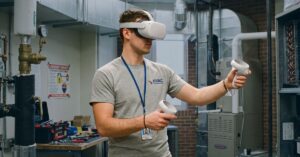
3D simulations can play a key role in training the next generation of manufacturing workers. This technology allows learners to learn by doing in a virtual environment that mimics field-like situations in a controlled, risk-free simulation.
Here’s why simulations are ideal for advanced manufacturing training.
1. Make Expensive Equipment Accessible to Every Learner
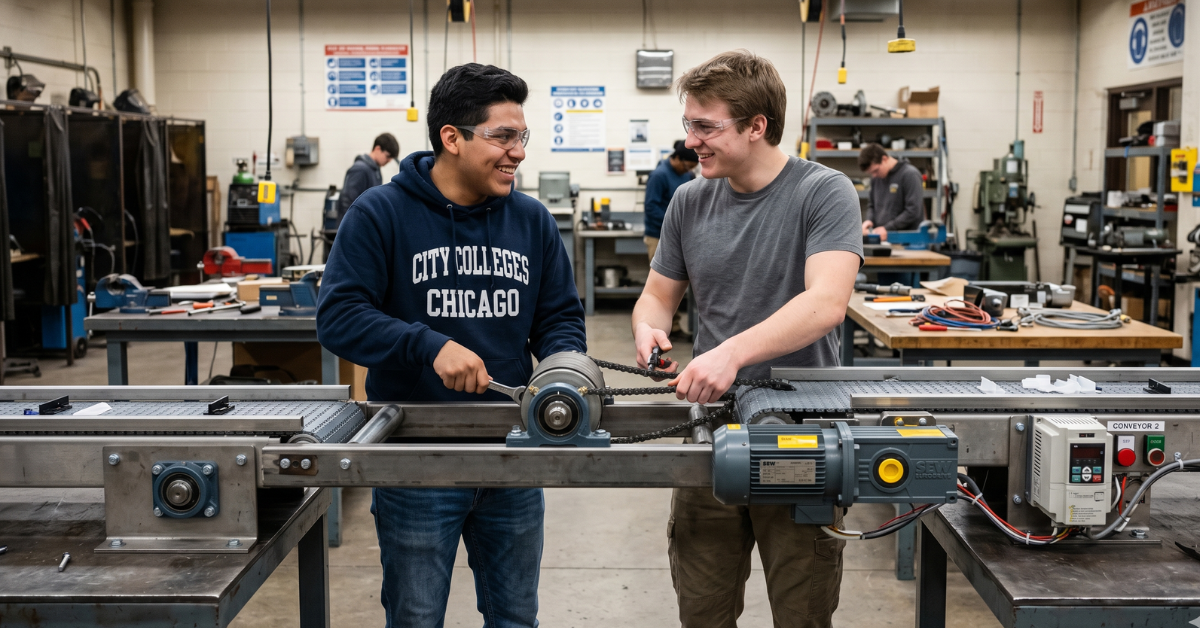
Industrial maintenance training equipment carries a price tag that most community colleges and workforce training centers simply can’t absorb. A single automated conveyor system or pneumatic trainer can cost tens of thousands of dollars even before you account for specialized maintenance or the physical parts that learners will wear out during troubleshooting practice.
But with a simulation, training programs can replicate the look, function, and dynamics of this equipment in a 3D virtual environment, giving learners hands-on experience without the high price tag. Since some simulations like Interplay Learning’s can be accessed on any device, learners don’t even need to be in the lab to practice.
2. Higher Retention and Effectiveness
Studies on simulation-based training show that learners recall information better and learn faster with hands-on practice. Traditional learning methods, like lectures, textbooks, and on-the-job observation often result in lower engagement and recall. One study found that students remember 90% of the material when learned through hands-on simulations like VR.
While lab time can offer that hands-on learning, it’s not scalable and comes with issues such as the price tag mentioned above, safety issues, and even space limitations. Immersive simulations can provide scalable hands-on learning and allow lab time to be safer and more advanced since learners cover the basics in simulations first.
3. Lower Risk of Safety Incidents and Downtime
Advanced manufacturing environments carry safety risks. Industrial robots, high-temperature additive processes, and live electrical systems can cause serious injury when handled by untrained workers. In a factory, you have the added pressure that human error can lead to costly downtime.
Simulations solve this by giving learners a no-fail environment to make mistakes, learn from them, and build the muscle memory they need before they ever touch real equipment. Recent studies confirm that VR-based training increases safety awareness by 30% in occupational settings compared to traditional methods, while also improving risk knowledge and self-efficacy.
4. Build Problem-Solving Skills
Critical thinking and problem-solving are two of the fastest-growing skills in manufacturing, growing at 20% annually. Because advanced manufacturing is all about precision and reducing waste, workers aren’t simply executing the same rote tasks over and over again. Instead, they’re troubleshooting problems, incorporating feedback, and optimizing for better outcomes.
Simulations work hand-in-hand with constructivist pedagogy to build real problem-solving skills. Instead of passive listening or observation, learners use active exploration to virtually navigate equipment, try different hands-on methods, and construct their own knowledge with trial and error.
Building a Workforce Pipeline for Advanced Manufacturing
Manufacturing is an exciting place to start a career. The sector is growing, salaries are competitive, and workers get to contribute to cutting-edge technological changes.
But traditional trade schools can’t keep up with the rapid demand and skills evolution. Organizations that create a scalable training infrastructure and offer hands-on, simulation-based learning can close the gap.
Get Started with Simulation-Based Workforce Training
Interplay Learning offers more than 500 hours of expert-led instruction and immersive simulations, built specifically for skilled trades and advanced manufacturing training. Our platform gives learners hands-on training from any device and gives instructors and administrators the tools to assign, track, and report on outcomes in one place.
Schedule a free demo with Interplay Learning today!