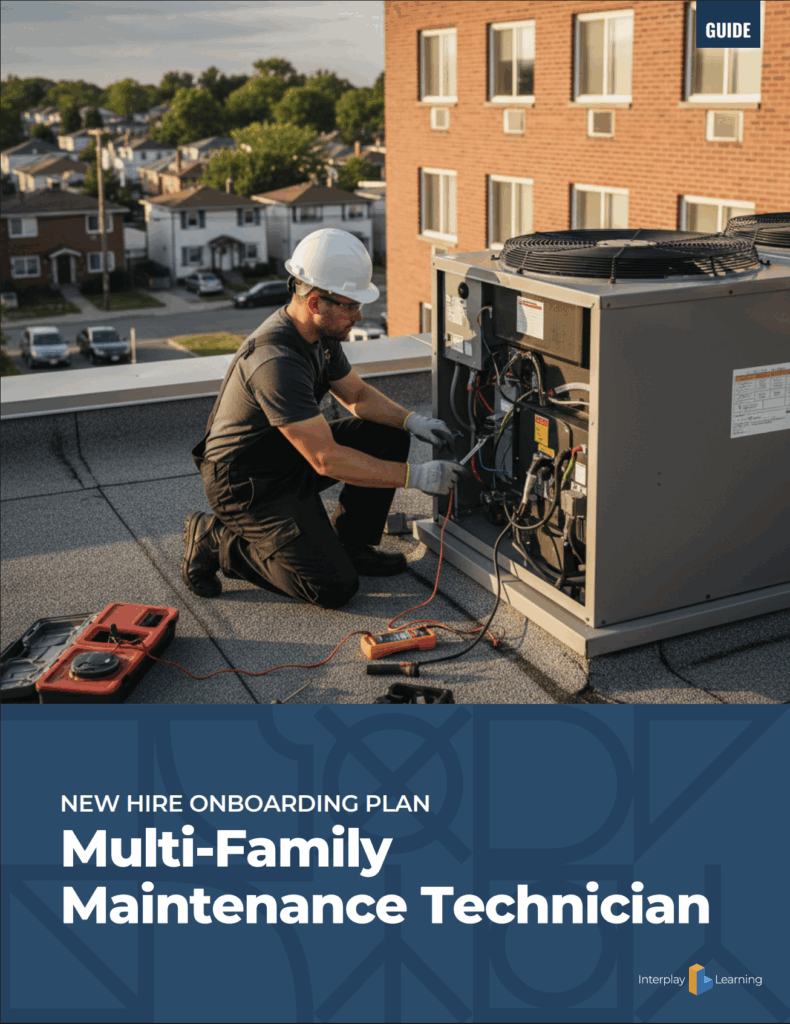
Onboarding Plan for Multi-Family Maintenance Technician
Training backed by digital content, immersive simulations, and expert instruction to drive real-world performance.
Onboard Your Technicians With Blended Learning
Summary
The first 90 days of onboarding multi-family maintenance technicians are critical but often slowed by outdated training methods, inconsistent shadowing experiences, and the need to wait for the “right” real-world scenarios. New hires struggle to gain confidence quickly, while senior techs lose valuable time repeatedly teaching the basics.
Interplay Learning’s 12-week onboarding guide for multi-family maintenance technicians solves this by delivering a structured, simulation-based training path that accelerates readiness and improves safety. The program blends immersive hands-on simulations, expert-led lessons, and guided on-site practice, allowing new hires to build essential skills before working on live systems.
Giving new hires hands-on, immersive training that builds confidence and keeps them safe from day one.
Helping new hires learn core skills independently so senior techs can focus on advanced troubleshooting and higher-value work.
Providing diverse, realistic troubleshooting practice without waiting for equipment failures or the perfect on-site scenario.
Training
Solutions
Standardize onboarding with a 12-week, simulation-based training plan designed for multi-family maintenance teams.
Use skill assessments and progress tracking to personalize learning at scale.
Blend digital lessons with supervised, hands-on practice for faster certification and retention.
Centralize content to unify terminology, safety standards, and procedures across campuses.
Outcomes
- Faster new-hire ramp-up and reduced training downtime.
- Stronger safety compliance and fewer preventable incidents.
- Higher first-time-fix rates and reduced maintenance callbacks.
- More consistent, resident-ready service across every property.
- Scalable, repeatable onboarding that grows with your portfolio.
Building a Smarter, Safer Workplace
Instead of pulling your top performers away from critical work to repeatedly teach the basics, Interplay Learning provides a platform where new hires can learn essential systems, safety protocols, and troubleshooting fundamentals independently—inside a simulated environment that feels like the real thing.
Interplay Learning changes the way multifamily teams onboard. By supplementing your training program with immersive, simulation-based learning, new hires can begin hands-on practice in a virtual environment from day one. This blended approach accelerates readiness and creates a more consistent, scalable onboarding experience across properties. This method offers several key benefits:
- Giving new hires engaging, hands-on training while keeping them safe.
- Ensuring new hires learn the basics independently so your top technicians can stay focused on advanced training and repair work.
- Providing realistic troubleshooting practice without waiting for equipment failures or specific on-site scenarios.
- Enabling cross-training across multiple job tasks, including HVAC, plumbing, electrical, and appliance repair.
90-Day Onboarding Plan with Interplay Learning
WEEK 1: FOUNDATIONS IN SAFETY AND COMPANY CULTURE
The first week focuses on establishing essential safety awareness, completing administrative tasks, and introducing new hires to your company’s culture. By covering Lockout/Tagout and HVAC safety basics early, technicians gain an immediate understanding of workplace hazards—reducing risk, liability, and preventable incidents. Orientation activities set clear expectations and prepare them for the structured learning ahead.
Company Orientation Activities
-
Complete all HR paperwork and benefits enrollment.
-
Receive company ID, access badges, and necessary IT equipment.
-
Learn the company mission, vision, and core values.
-
Review the property’s emergency response, fire safety, and evacuation plan.
-
Shadow the Maintenance Supervisor for a half-day tour of the property, key personnel, and the maintenance shop.
Interplay Learning Courses
- Complete the Interplay Learning Navigation Guide to learn how to use the training platform.
- Take the Multi-Family Maintenance Welcome Assessment to establish a baseline of knowledge.
- Complete HVAC Safety Basics (HVAC107) for an overview of general and electrical safety.
- Complete Lockout/Tagout (ELEC112) to understand procedures for de-energizing equipment.
WEEK 2: FACILITIES OVERVIEW AND PERSONAL SAFETY DEEP DIVE
This phase minimizes common human resource risks and provides context for future tasks. Training on PPE and Ladder Safety directly reduces the chance of minor injuries and lost time associated with falls, the most common cause of injury in the trades. The Facilities Maintenance Introduction shows new hires the full scope of their work, ensuring they understand their role is multi-faceted and crucial to overall operations and resident satisfaction.
Interplay Learning Courses
- Complete Facilities Maintenance Introduction (FM101) to understand the scope of the job, covering interior and exterior maintenance.
- Complete Personal Protective Equipment (PPE) (SAF215), focusing on protection for head, hands, feet, eyes, and hearing.
- Complete Ladder and Fall Safety (HVAC053).
- Complete Preventing Slips, Trips, and Falls (SAF217), addressing hazards often overlooked by new employees.
On-site Training
- Complete a detailed walkthrough of a vacant unit with a veteran technician, noting all major systems (HVAC, plumbing, electrical).
- Locate and demonstrate how to shut off the main utility sources (gas, water, electric) for the entire property.
- Practice properly inspecting, setting up, climbing, and putting away a ladder in accordance with safety guidelines.
WEEKS 3–4: PLUMBING SYSTEMS AND FIXTURES
Plumbing issues represent a large volume of immediate maintenance calls and pose a high risk of property damage. This two-week block focuses on quickly enabling the new hire to resolve the most common leaks and clogs independently. The courses, such as How Does Plumbing Work and Plumbing Fixtures Overview, provide the contextual “why” behind plumbing system design, allowing for logical troubleshooting rather than simple guesswork, thus increasing the first-time fix rate for minor work orders.
Interplay Learning Courses
- Complete How Does Plumbing Work? (PLMB100) to understand how water and waste systems are set up.
- Complete Basic Plumbing Tools (PLMB101) to become familiar with the necessary equipment.
- Complete Plumbing Fixtures Overview (PLMB103), focusing on lavatories, sinks, tubs, and toilets.
- Complete Fittings and Valves (PLMB113) to learn about common connection parts and valve types.
- Complete Tubular and Fixture Trim (PLMB115), covering tailpieces, traps, and supply trim.
On-site Training
- Shadow a technician on at least three different toilet troubleshooting and repair tasks.
- Practice cleaning a common fixture clog (sink, tub, or lavatory) using manual clearing equipment.
- Demonstrate proficiency in identifying and correctly re-caulking bathtub/shower and counter seams.
- Assist a technician with a water heater maintenance task, including a sediment flush.
WEEKS 5–6: ELECTRICAL SYSTEMS AND SAFETY
Electrical competence is foundational for all high-value maintenance work (HVAC, appliances, lighting). This period concentrates on the proper use of test instruments and understanding basic residential circuits. By mastering the multimeter, new hires gain the ability to reliably diagnose faults and confirm de-energization. This helps ensure that they do not misdiagnose common electrical issues, and it promotes safety during the troubleshooting of energized equipment. This capability allows them to take on basic electrical work orders with confidence.
Interplay Learning Courses
- Complete Fundamental Electrical Concepts (ELEC101) covering charge, current, voltage, power, and resistance.
- Complete Electrical Panels: Components and Safety (ELEC102) focusing on connections, breakers, and GFCI/AFCI devices.
- Complete How to Use a Multimeter (ELEC113), practicing voltage, resistance, and amperage measurement.
- Complete Electrical Devices (ELEC111), covering receptacles, circuit breakers, and light switches.
On-site Training
- Perform a live-dead-live check using a multimeter to confirm a circuit is de-energized before beginning work.
- Practice replacing a standard duplex receptacle and a light switch under supervision.
- Practice tripping and resetting circuit breakers and identifying the panel labeling standard on the property.
- Shadow a technician on an electrical service call involving a tripped GFCI or AFCI breaker.
WEEKS 7–8: HVAC AND REFRIGERATION BASICS
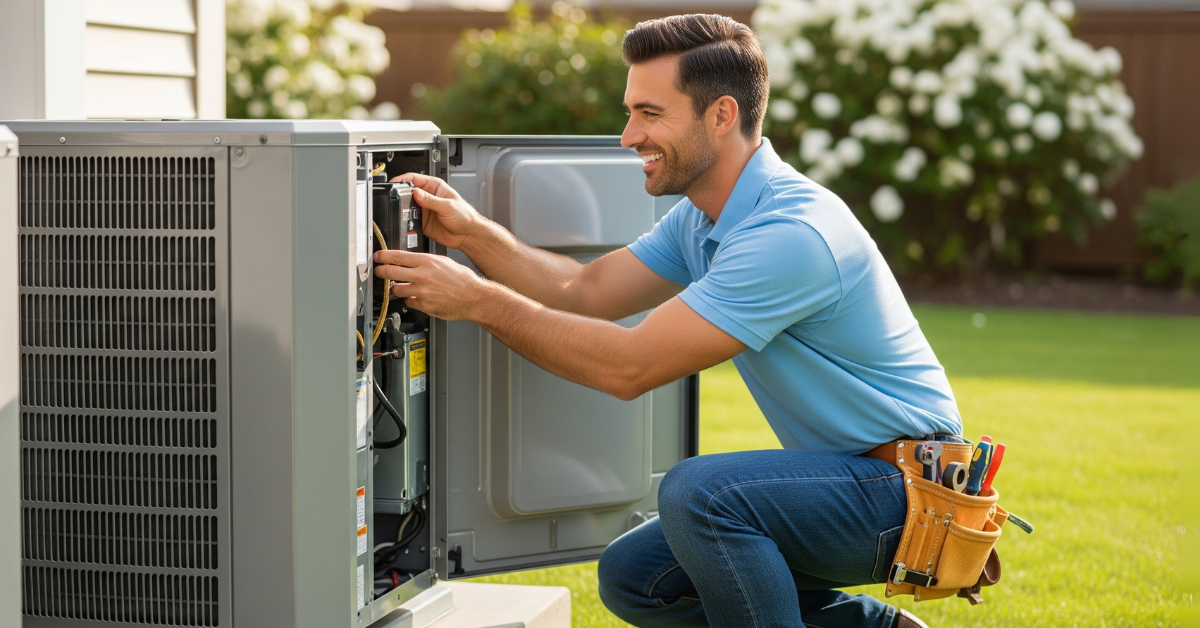
This week’s focus is on building troubleshooting confidence through a structured approach. New technicians apply what they’ve learned about different systems and preventive maintenance to identify root causes of common HVAC, plumbing, and electrical issues found across campus. Simulation-based learning allows them to practice diagnosing problems safely before tackling real-world tasks under supervision.
Interplay Learning Courses
- Complete What is HVAC? (HVAC050) to understand the industry and system placement.
- Complete Temperature, Pressure, and Heat (HVAC102) to learn the physics behind cooling and heating.
- Complete Introduction to Refrigeration Systems (HVAC101), focusing on the “Baseball Diamond” concept.
- Complete HVAC System Parts (HVAC052), covering major refrigeration and heating parts.
On-site Training
- Assist a technician with seasonal maintenance on a split A/C unit, focusing on coil cleaning and visual inspection.
- Complete an inventory check for common HVAC consumables (filters, fan belts, start components).
- Locate and identify the four major refrigeration components (compressor, condenser, metering device, evaporator) on at least three different HVAC units.
WEEKS 9–10: MULTI-FAMILY CORE PROCESSES AND APPLIANCES
This two-week period focuses on the high-volume, high-visibility tasks that directly impact tenant satisfaction and unit turn time. The cornerstone is the “Make Ready” process, which, when performed efficiently, minimizes vacancy loss. By adding core appliance troubleshooting (dishwasher, electric range), the technician reduces the need to schedule and pay third-party vendors, immediately increasing efficiency and speed of service.
Interplay Learning Courses
- Complete Make Ready (MFAM200) simulations and assessments to understand the inspection structure.
- Complete Dishwasher Troubleshooting (APPL202).
- Complete Electric Range Troubleshooting (APPL201).
- Complete Repairing Drywall (MFAM102), covering patches for various-sized holes.
- Review the Make Ready Checklist.
On-site Training
- Shadow a complete Make Ready turnover process (inspection, work ordering, and quality check) from beginning to end under supervision.
- Practice small and large hole drywall patching using the methods learned in the course.
- Independently troubleshoot and repair two common appliance faults (e.g., dishwasher won’t drain, range element won’t heat).
- Complete a light commercial lamp or fluorescent tube replacement on an exterior or common area fixture.
WEEKS 11–12: ADVANCED TROUBLESHOOTING AND PROFESSIONALISM
The final module integrates high-level technical skills (A/C and Toilet Troubleshooting) with essential soft skills (Avoiding Callbacks, and Dealing with Difficult Customers). This is where the new hires transition from task-doers to problem-solvers and customer service agents. Mastering these final components directly impacts resident retention and reduces costly rework (callbacks), confirming the new hires are ready for autonomous field work.
Interplay Learning Courses
- Complete Toilet Troubleshooting and Replacement (PLMB202) simulations.
- Complete Residential A/C Troubleshooting (HVAC301) simulations covering electrical and mechanical faults.
- Complete Dealing with Difficult Customers (PROFDEV103), learning de-escalation and problem-solving techniques.
- Complete Avoiding Callbacks (PROFDEV101), focusing on thorough diagnosis and clear communication with the customer.
On-site Training
- Lead one advanced troubleshooting call on an A/C system (e.g., hard-start kit failure, pressure fault diagnosis) and successfully complete the repair.
- Lead a toilet repair/replacement call, correctly diagnosing the fault and performing the repair.
- Practice diffusing a difficult customer scenario in a role-playing exercise with the Maintenance Supervisor or veteran technician.
- Compile a “Go-Bag” of the most essential tools and materials based on the last 11 weeks of experience.
On-site Training
- Retake the Multi-Family Maintenance Welcome Assessment and create a personalized plan for continuous learning.
- Pass the Residential A/C Troubleshooting and Toilet Troubleshooting and Replacement assessment simulations.
ACCELERATE NEW HIRE READINESS WITH INTERPLAY LEARNING’S MULTI-FAMILY MAINTENANCE ONBOARDING GUIDE